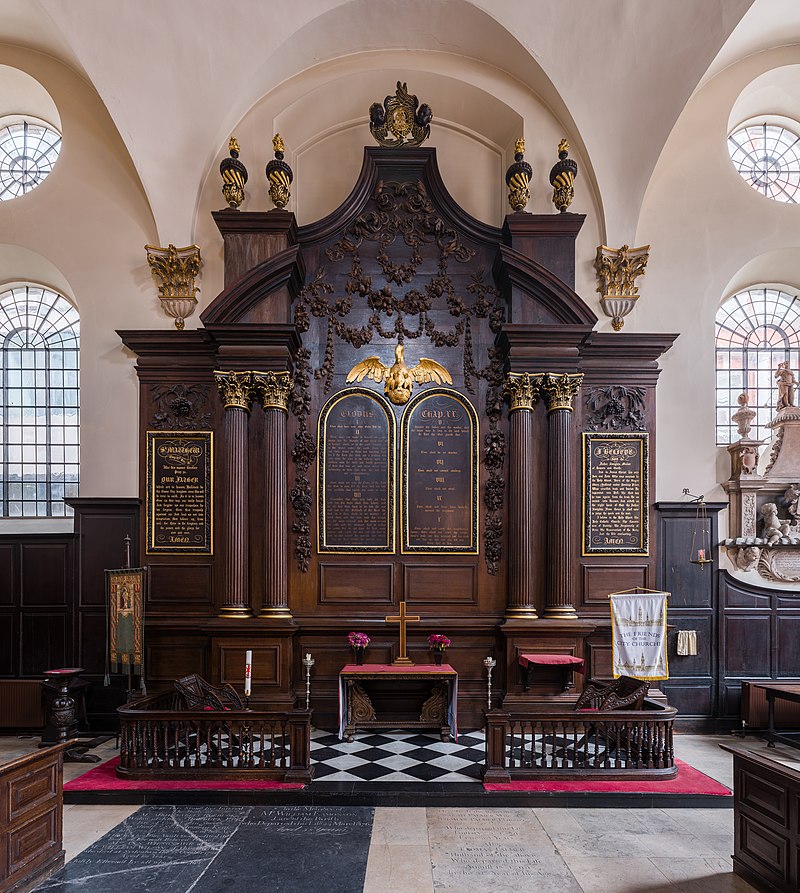
Three carvings and metalwork1686 and later
Look for it: Gilded pelican on Grinling Gibbons's reredos; Robert Bird's copper weathervane above the north door; a third on the post-war rectors' board
The church's own guide identifies all three motifs and explains their connection to Corpus Christi College, Cambridge.
◌ Usually open on selected weekdays; check the church calendar before travelling.
Freestanding wood carving1775
Look for it: Church interior
The church guide dates its Pelican in her Piety to 1775; the statutory list also records the carving.
◌ Open around services and weekday events; check ahead.
Reredos carvingLate 17th century
Look for it: Dominating the centre of Grinling Gibbons's reredos
The church's building guide explicitly identifies the pelican and its Eucharistic meaning.
◌ Normally open daily outside services and events.
Carved relief17th century
Look for it: Near the font in the small north-side room
Two architectural accounts identify the pelican-and-young relief beside the font.
◌ Limited weekday opening; check before travelling.
Font-cover finial19th century
Look for it: Crowning the elaborate timber font cover
The statutory list describes the font cover as crowned by a pelican in her piety.
◌ Usually accessible around Mass and parish opening times.
Stained-glass roundel19th century
Look for it: St Saviour's Chapel
Historic England records the roundel; Heritage of London documents its restoration by Chapel Studio.
◌ Check service and opening times.
Metalwork relief1907
Look for it: Above the gates to the Blessed Sacrament Chapel
The statutory list identifies the Pelican in her Piety over Marshall's 1907 grilles.
◌ Cathedral normally open daily; chapel access may vary during worship.
White-marble roundelEarly 20th century
Look for it: Above the aumbry in the chancel
Historic England records the roundel; it was erected in memory of Prince Francis of Teck.
◌ Public opening is intermittent and event-led; check the chapel programme.
Painted ceiling emblem1870s
Look for it: Centre of the chapel's dome
The statutory list describes musician angels around a central pelican in piety.
◌ Inside a working children's hospital; access is controlled and should be arranged.
Ceiling tiles1850s
Look for it: Baptistery ceiling
The baptistery's marble-and-tile scheme includes a prominent pelican in her piety.
◌ Church is regularly open; avoid services and private events.
Gilded timber finialEarly 20th century
Look for it: Top of J. Harold Gibbons's Gothic-Rococo font canopy
The statutory list calls out the pelican finial on the font canopy.
◌ Open around services; check ahead.
White-marble reliefInstalled 1958; earlier fabric
Look for it: Central roundel on the St Gregory altar beneath the north gallery
The Survey of London describes the round plaque in high relief and traces the altar's move from Foxcote House.
◌ Normally accessible around Mass and parish opening times.
Stained glassPost-war
Look for it: Centre of Marion Grant's east window, beneath the saints
The Survey of London explicitly locates the pelican in piety in the east window.
◌ Church is regularly open for worship and community use.
Marble memorial reliefc. 1800
Look for it: Monument to Dame Ann Frances Hoare
A detailed photographic study identifies the pelican feeding her brood on the Hoare monument.
◌ Check church opening times; the memorial is inside.
Pelican lectern19th century
Look for it: Transferred here from St Paulinus, St Paul's Cray
Historic England records the lectern and its transfer to St Mary Cray.
◌ Open around services and parish events; check ahead.
Gilded reredos carving17th century
Look for it: Centre of the relocated reredos from All Hallows Lombard Street
The great reredos preserves a gilded pelican feeding her young, moved here with other City-church fittings.
◌ Open around services; check with the parish for visits.
Silver-gilt tabernacle doorLate 19th century
Look for it: High altar in the chancel
Both the statutory list and Taking Stock describe the vulning pelican on the tabernacle door.
◌ Normally accessible around Mass; respect liturgical use.
Apse mosaic1895
Look for it: Symbolic band beneath the apse windows
The statutory list names the Pelican in her Piety alongside the phoenix in the mosaic band.
◌ Now in Orthodox use; arrange access through the current congregation.
Carved stone capital19th century
Look for it: Stair hall capital
Historic England describes the capital as carved with a pelican in her piety, goblets, and the head of Bacchus.
◌ Private redevelopment site; there is no routine public interior access.
Stained glass1904
Look for it: South thermal window
The statutory list identifies the Pelican-in-her-Piety glass in the mausoleum's south window.
◌ The cemetery is visitable; the mausoleum interior is normally closed.
Medieval misericordMedieval; rehoused 1951
Look for it: Chapel misericord, with three chicks and swan supporters
A photographic inventory identifies the misericord; the foundation documents the chapel's history.
◌ The foundation is active; chapel visits should be arranged or made during an open event.
Historic stained glassEarly glass reset in later windows
Look for it: Among the church's old stained-glass fragments
The Royal Commission inventory records old glass depicting a pelican in her piety.
◌ Church and churchyard are regularly accessible; check interior opening.
Stained glassPost-war
Look for it: East window by Carl Edwards
An identifiable photographic record shows the motif; the church attributes its windows to Carl Edwards.
◌ Usually open daily; services and RAF events take priority.
Altar-piece carving18th century
Look for it: Centre of the scrolled pediment above the altar-piece
The Survey of London describes the pelican feeding her young on the surviving altar-piece.
◌ Church is regularly open; check current hours.
Medieval stone carvingsc. 1520, with later restoration
Look for it: Repeated on Bishop Richard Fox's Great Screen, immediately above the rows of angels
The cathedral identifies the pelican as Bishop Fox's badge and regards the small carvings as probably original.
◌ Normally open daily; visitor charges or service restrictions may apply.
Wood carvingProbably Victorian
Look for it: Reredos in the adjoining chapel
A detailed architectural photographic survey identifies the self-sacrificing pelican feeding her young.
◌ Check parish opening and service times.
Painted decorative panel19th-century decorative scheme
Look for it: Chapel interior
A clearly identified photograph records the chapel's pelican in her piety; the chapel publishes current visiting information.
◌ Normally open Monday–Thursday and for Sunday worship; check temporary closures.
Stained glassPost-war
Look for it: Great East Window
An identified detailed photograph locates the pelican in her piety in the Great East Window.
◌ Cathedral is normally open daily; respect Mass and private liturgies.